Energy conservation is a key component of any sustainable development initiative. In France, the Tertiary Decree serves as a guiding principle for achieving this goal. But what exactly is the Tertiary Decree, and how will it help reduce energy consumption?
Definition and Purpose of the Tertiary Decree
The Commercial Buildings Decree is a document that outlines the measures to be taken to reduce energy consumption in commercial buildings. As a reminder, a commercial building is a building or premises used for commercial activities.
Since the building sector accounts for 43% of energy consumption in France, this decree is of paramount importance in that it helps reduce the sector’s energy impact. That said, we must start by focusing on this primary source of energy consumption.
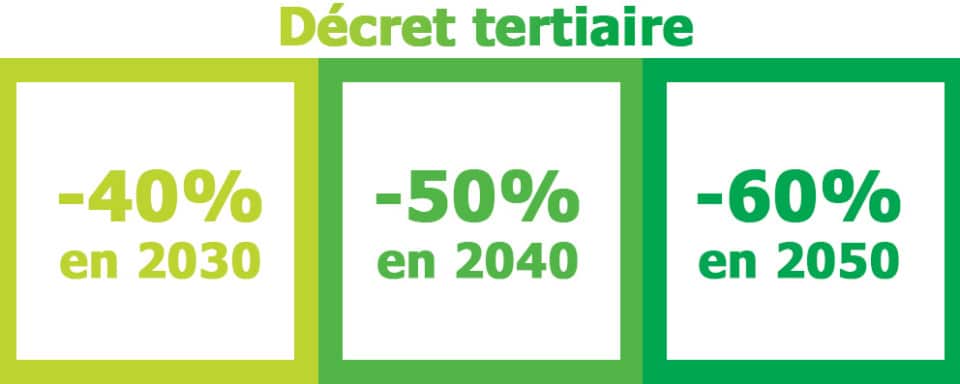
The goal of the tertiary sector decree is to reduce energy consumption in three stages:
- A 40% reduction by 2030;
- Another 50% by 2040;
- A 60% reduction by 2050.
To effectively carry out this mission, concrete measures have been proposed. These focus on energy-efficient renovations of commercial buildings, their systems, and their equipment. This will improve their energy performance while significantly reducing their energy consumption.
Scope of the Tertiary Decree
It is important to note that this decree applies to buildings that fall into one of the following three categories:
- Commercial space located in a building with a floor area of 1,000 square meters or more;
- A commercial building with a floor area of 1,000 square meters or more;
- Commercial buildings smaller than 1,000 square meters located on the same site, where the total floor area is 1,000 square meters or more.
Furthermore, the implementation of the tertiary sector decree applies to both property owners and tenants. Although the scope of responsibility differs for each party, all parties have a share of responsibility to fulfill. In the event of non-compliance with the decree, those subject to it face penalties ranging from a fine of 7,500 euros per establishment to the publication of their names on a government website under the “Name & Shame” section.
Examples of actions to take
It’s a good idea to think about reducing your energy consumption. But what concrete steps can you take?
The first step would be to raise as much awareness as possible among occupants and staff about the need to change their behavior. We need to encourage them to adopt more energy-efficient habits. Thus, working to change attitudes would be an excellent starting point.
Next, steps must be taken to improve the building itself in order to reduce its energy consumption (self-consumption, insulation, heating, etc.). This significantly reduces energy use while maintaining a high level of performance.
Finally, the implementation of an automated system to manage energy consumption in the building also meets the objectives of the decree. In fact, installing Enless Wireless sensors in a building and analyzing the collected data results in an average 25% reduction in energy consumption as early as the first year.
The technologies developed by Enless Wireless (Wireless M-Bus, LoRaWAN, Sigfox) enable both the control of building systems and the monitoring of energy consumption and comfort levels. Click here to view Enless Wireless products.