What is Cerema?
Cerema is a public institution under the Ministry of Ecological and Solidarity Transition. As a specialist in energy efficiency and building asset management, its mission is tosupport public and private stakeholders in the building sector with their challenges, including building design, urban planning, maintenance and operations, renovation projects, and energy optimization.
It is thus involved in every phase of the projects it supports, from identifying solutions to operational implementation. Cerema’s primary focus is on integrating buildings into their surroundings, within the context of environmental and ecological transition.
Cerema is also involved in developing new regulations to promote positive energy buildings and regulate carbon footprints. In particular, it has worked to develop a method for assessing the environmental performance of new buildings: the E+C- pilot program, which is being conducted throughout France.
To learn more about Cerema’s activities and the 2020 environmental regulations it supports, visit the Cerema website.
The THEMIS Connected Energy Performance Monitoring Solution

In line with its commitment to supporting stakeholders in the construction sector, Cerema’s Clermont-Ferrand office developed the THEMIS system— Thermic and Energetic Monitoring System — a connected solution designed to synchronize in real time the measurements taken within a building as part of its BMS.
The data, which primarily relates to monitoring the building’s energy performance, is collected using sensors positioned at strategic locations on the site to be monitored and is aggregated and analyzed via the THEMIS platform, often as part of construction or renovation projects.
The collected data (indoor and outdoor temperature, humidity, CO2 levels, instantaneous electrical power, gas pulses, etc.) can be combined with climate data from nearby weather stations. With the appropriate configuration, THEMIS can also communicate with boiler room controllers using the Modbus RS485 protocol.
The platform’s modular design allows for fine-tuning of features and adaptation to projects of any type and size, catering to all types of stakeholders in the building construction and renovation sectors.
The thermal audit project conducted for Allier Habitat
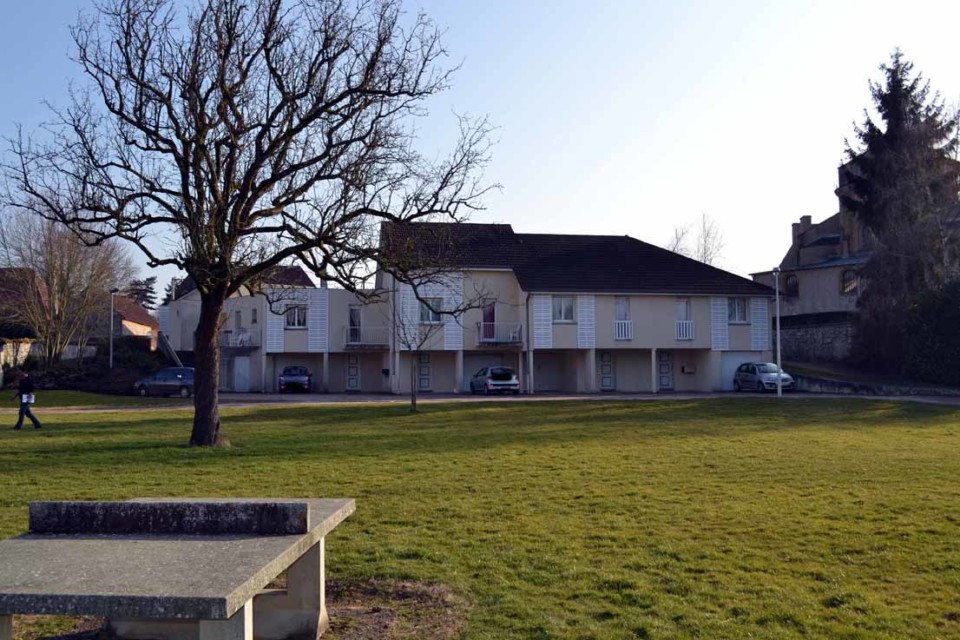
The energy efficiency project was carried out for Allier Habitat—formerly the Allier Departmental Public Office for Affordable Housing—a social housing provider that owns some 4,600 units spread across 140 municipalities in the Allier department.
This project was initiated in response to the developer’s need to compare various thermal insulation techniques across a number of its lots in order to select the best option.
This audit project was conducted a few months ago by Cerema.
The on-site installations involved the implementation of automated systems for collecting energy and comfort data using various sensors installed in the relevant areas.
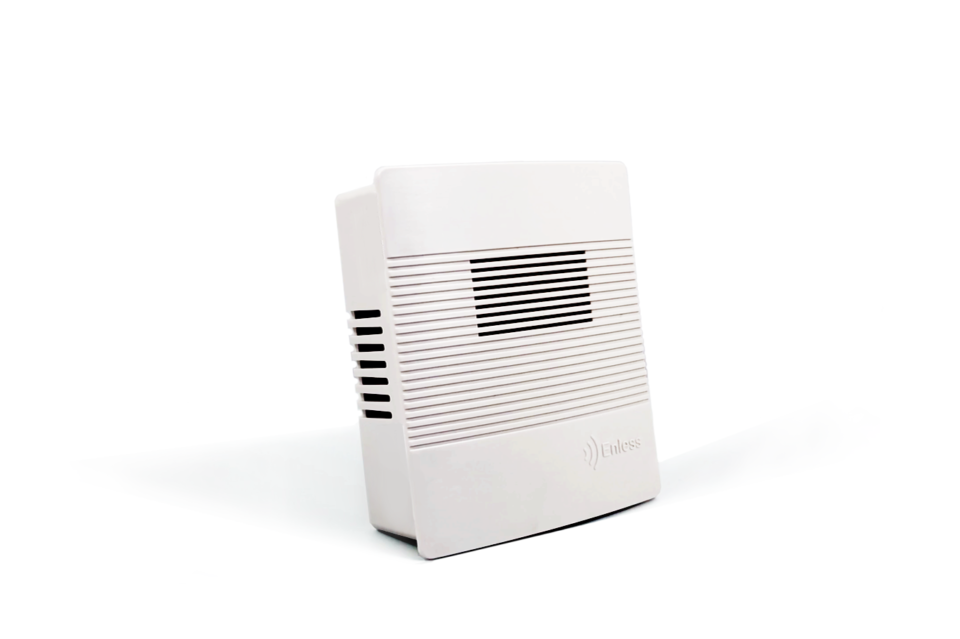
Among other things, a dozen Enless Wireless temperature and humidity transmitters, operating on the 169 MHz Wireless M-Bus radio communication protocol, were installed in a complex of three detached houses (built in 1975). The distance between each house was approximately thirty meters.
During the implementation phase, which was carried out using Enless Wireless’s A.I.R. software, the polling interval was set to 5 minutes to enable frequent data transmission to an Enless Wireless Modbus receiver, also installed on-site. The receiver was paired via Modbus with an Advantech Smartflex gateway.
The installation of the equipment has enabled real-time data transmission to the THEMIS historical database, developed by Cerema and easily accessible online via a specific web address.


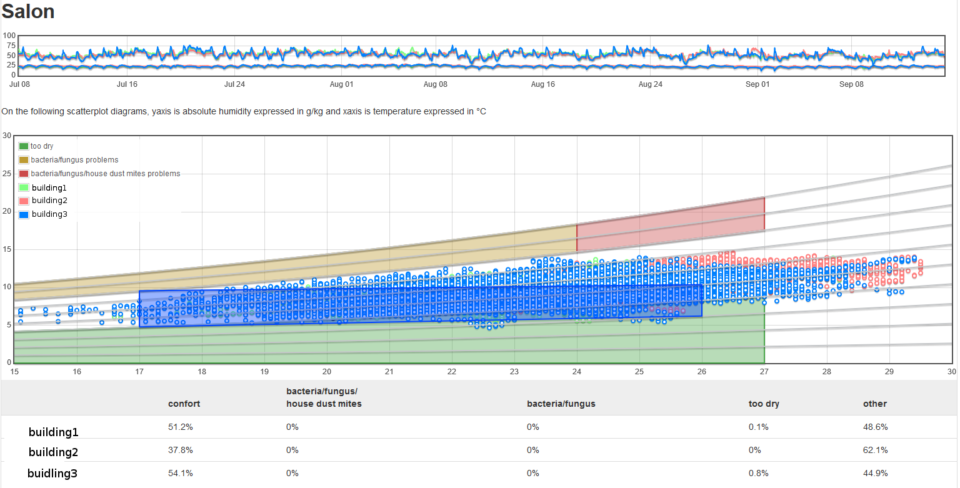
Examples of thermal data visualization and archiving using the THEMIS system at different scales: a comparative view of the three batches, detailed batch analysis, and room-level data visualization.
The data collected in real time, combined with other parameters (nearby weather stations, the open-source energy monitoring system Emoncms, etc.), enabled the modeling of heat loss through air infiltration, solar gain, and wind speed. “Field” U-values (building envelope heat loss coefficients) were thus determined for each thermal insulation system evaluated. The lower the measured U-value, the more efficient the building envelope was deemed to be.
“The system we implemented worked very well,” says Alexandre Cuer, Deputy Director of Cerema Clermont-Ferrand. “Installing the Enless transmitters was straightforward, and the overall system performed flawlessly, without any interruptions. The solution enabled our client, the housing authority Allier Habitat, to decide which thermal insulation method to usefor its new construction projects. ”
Click on the icons below to share this article on social media >>>