Various measures of indoor air quality in a building help ensure the comfort and health of its occupants. Most people spend up to 80% of their time indoors (at work, in public facilities, schools, etc.).
There are many sources of pollution in a building (carbon dioxide, building materials, household and cleaning products, etc.). As a result, indoor air is more polluted than outdoor air. Furthermore, since the start of the COVID-19 pandemic, 75% of infections have occurred in indoor settings. It is therefore essential to ensure good indoor air quality in buildings.
What pollutants are found in indoor air?
In order to measure indoor air quality (IAQ), it is first important to understand which pollutants are present in indoor air and their effects on health.
In any building, indoor air contains several components that play a major role in indoor air quality (IAQ). The various aspects of indoor air quality primarily focus on:
- CO2 (carbon dioxide)
- VOCs (Volatile Organic Compounds)
- The temperature
- Humidity
The carbon dioxide (CO2) level is the primary indicator of indoor air quality. Carbon dioxide is naturally present in the air due to human presence. At normal concentrations, CO2 levels are not a cause for concern. However, high CO2 levels in a building can be a source of pollution and cause numerous problems. High carbon dioxide levels are often caused by a room filled with people or a lack of air exchange (ventilation, air circulation).
Volatile Organic Compounds (VOCs) are pollutants found in indoor air. Unlike CO2, VOCs do not result from human presence. They come from building materials, furniture, paints, solvents, household products, plastic-based products, and so on. However, just like CO2, high levels of VOCs in indoor air can be a source of pollution in buildings.
High levels of CO2 and VOCs in your buildings negatively impact indoor air quality and the well-being of occupants. In fact, the presence of these pollutants in indoor air can cause:
- Many symptoms (fatigue, drowsiness, headaches, allergies, respiratory problems, etc.)
- A decline in workplace productivity
- A decline in productivity due to learning in schools
- An increase in the spread of COVID-19
Temperature and humidity also play a role in indoor air quality (IAQ). Temperature and humidity contribute to the proliferation of volatile organic compounds in indoor air. Temperatures that are too high or too low can cause discomfort and lead to poor working conditions. Furthermore, an overly heated facility promotes the development of airborne pollutants. An excessively humid facility, on the other hand, leads to mold growth or structural deterioration.
What are the regulations regarding indoor air quality?
Given the adverse effects caused by airborne pollutants, French law made it mandatory in 2018 to monitor indoor air quality in certain public facilities (Articles L. 221-8 and R. 221-30). This law applied only to preschools, elementary schools, and daycare centers.
- Since 2020, other public facilities, such as higher education institutions and recreational facilities, have been required to monitor the main pollutants in indoor air.
- By 2023, all other public-access facilities will be subject to these regulations. It will therefore be mandatory to monitor indoor air quality and be able to measure the main pollutants.
However, air quality can vary considerably depending on pollutant concentration levels. As a result, public health authorities recommend limiting CO2 and VOC concentration levels in enclosed public spaces to ensure the comfort and health of occupants.
Regulatory CO2 limits:
CO2 levels are measured in ppm. ANSES has published a table showing the various CO2 concentration thresholds. Above 600 ppm, indoor air quality deteriorates and can be hazardous to occupants:

Regulatory VOC thresholds:
VOC levels can be measured in ppb ( parts per billion).
1 ppb = 4.5 µg/m³ (micrograms per cubic meter of air).
Thus, for a measured concentration of 250 ppb, the value in µg/m³ will be 1,125 µg.
As shown in the table below,the World Health Organization provides recommendations—such as ventilation—for each level of VOC concentration in the air. At concentrations above 1,000 µg/m³, air quality deteriorates, and corrective measures such as ventilation are recommended:

Specified temperature limits:
It is important to monitor the temperature, as it plays a role in indoor air quality. In fact, excessively high temperatures can increase the presence of pollutants in indoor air. Temperature can also affect working conditions.
The French government has established temperature limits for commercial buildings. Article R.241-26 states that “the upper limits for heating temperatures are set at an average of 19°C.” This applies to public institutions, schools, and commercial premises.
Recommended humidity:
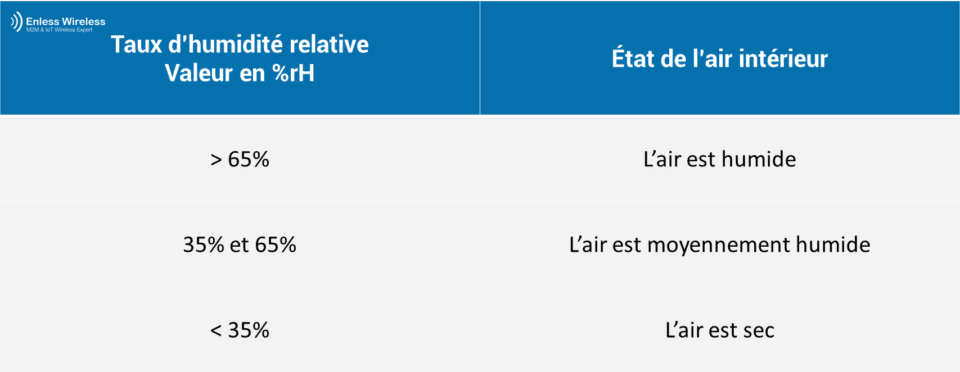
Monitoring humidity levels in buildings is just as important. High humidity levels in a building contribute to the proliferation of airborne pollutants. To measure humidity in a building, we use the term "relative humidity" (RH), which is measured as a percentage ranging from 0 to 100%. As shown in the table below, it is recommended that the humidity level be between 35% and 65%:
What are some ways to measure indoor air quality?
Many companies handle the installation and monitoring of indoor air quality in buildings. These include, for example, operators specializing inbuilding energy efficiency who rely on networks of regional integrators. These operators are responsible for implementing technical solutions to make buildings smarter and better serve their occupants.
Installing smart devices is a smart solution for measuring indoor air quality in buildings. These devices are specifically designed to monitor indoor air quality. They can accurately track CO2 and VOC levels, as well as temperature and humidity, in real time within an indoor environment.
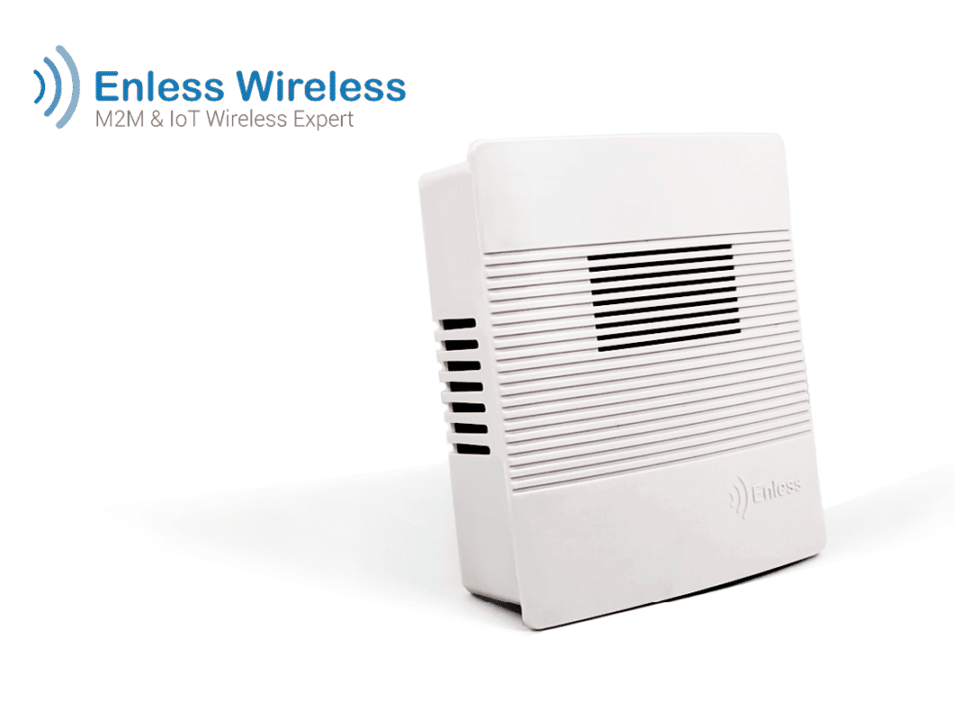
The Enless Wireless indoor air quality and comfort sensor allows you to measure indoor air quality in commercial buildings and public facilities. With sensors for CO2 ( ppm), VOCs ( ppb), temperature ( °C), andhumidity(%rH), Enless Wireless sensors focus on key pollutants to effectively measure indoor air quality. Installing these sensors in a building ensures compliance with government, environmental, and health laws and requirements regarding indoor air quality monitoring.
If regulatory CO₂ and VOC levels are exceeded, corrective measures (such as ventilation, for example) are recommended to improve air quality:
- Renewal of indoor air (ventilation, air exchange, mechanical ventilation, opening windows or doors),
- Evacuation or restriction on the number of occupants in an indoor environment.