
In addition to the well-known historic international and continental environmental agreements, the industrial sector has adopted numerous regional guidelines aimed at protecting the environment through the reduction of greenhouse gas emissions.
It is important to note the specific regulations governing facilities that incorporate combustion processes, depending on the level of electrical power generated. Massive emissions of CO2, particulates, SO2, H2O, and the associated temperature and pressure variations, necessitate fairly strict standards for gas analysis systems (CEMs) (including real-time marker analysis every 10 seconds), as detailed in the document published by Gimelec* in connection with the Inaugural Conference of its Gas Analyzer Committee Members.

Diagram illustrating typical gas and particle emissions from combustion processes. Source: Gimelec documentation
While the standards for combustion facilities are very strict, these facilities are not the only industries affected by air quality monitoring requirements, and it is worth noting that the levels of sensitivity vary widely.
Certain industrial processes, such as those that form the basis of the wine industry in the Bordeaux, Burgundy, and Provence-Languedoc regions, are also subject to specific requirements. In this particular case, the sensitivity stems more from health concerns, since alcoholic fermentation—an essential step in winemaking—produces significant releases of CO2. These CO2 emissions near the tanks can pose a potential danger to personnel, hence the need to monitor the carbon dioxide level in the environment to ensure it does not exceed the threshold of 0.5% (the normal level in the air is around 0.03%). Installing CO2 sensors near the tanks, such as CO2 transmitters from the 169 MHz Wireless M-Bus series and Sigfox ranges from Enless Wireless, coupled with controllers or platforms for visualization, data analysis, and alerts, can be an effective solution. It should be noted that since CO2 is odorless and colorless, and CO2 poisoning manifests itself well before the effects of oxygen depletion, it is impossible to assess the risk through sensory perception alone.
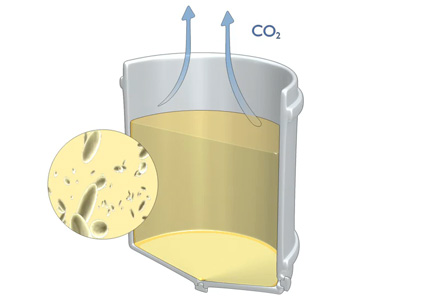
Monitoring carbon dioxide emissions then makes it possible to assess the effectiveness of existing CO2 extraction systems, implement systems to offset the extracted flow with an equivalent flow of fresh air, or plan for the installation of fans…
The construction sector is no exception either. We recall the Government Decree No. 2012-14 providing for the implementation in France of air quality monitoring in public buildings such as schools, daycare centers… But that’s not all. Public cultural venues are also affected; this is the case for the Carré d’Art in Nîmes , which was recently equipped with about forty Enless Wireless 169 MHz Wireless M-Bus CO2, temperature, and humidity sensors by one of France’s leaders in the energy transition, Engie Cofely. This monitoring system was designed to protect both the public and the artworks, with a focus on sustainability. It has also enabled a 30% reduction in energy management costs.

Engie Cofely has equipped the Carré d’Art in Nîmes with 40 Enless Wireless temperature, humidity, and CO2 sensors.
The Enless solution can thus meet government, environmental, and health requirements for air quality monitoring in several ways. The Enless Wireless temperature, humidity, and CO2 transmitter is available in Sigfox and Wireless M-Bus. It allows for a configurable reporting frequency—for example, every minute—and features high environmental tolerance (-20°C / +55°C).
Enless also plans to release its new transmitter for VOCs, CO2, ambient temperature, and humidity, which will also measure particle levels.
* Association of the Electrical Equipment, Control Systems, and Related Services Industries
Click on the icons below to share this article on social media >>>