
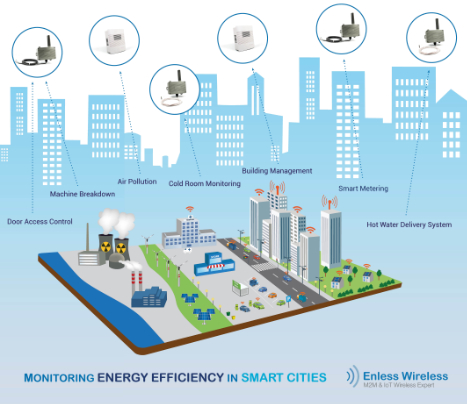
Smart Cities: A Necessary Transition
Today, 82% of France’s population lives in urban areas, and more than half live in city centers*. In 2019, the world’s 21 megacities (cities with a population of over 10 million) alone consumed 60 to 80% of the planet’s resources**. These demographic and behavioral trends, which have been growing exponentially over the past few decades, are inexorably pushing cities toward greater sustainability.
Provisions in French law also address this issue. Among the most recent measures are the multi-year energy plans (PPE) published by the government in early 2019 to lay the foundation for France’s energy future in the coming years (through the National Low-Carbon Strategy—SNBC—which outlines the measures and levers needed to successfully implement this new green economy).
It was against this backdrop that the concept of smart cities emerged in 2010. It involves optimizing urban spaces, infrastructure, and services to enhance residents’ quality of life, safety, and mobility while making the most of available environmental resources. It relies on technological advancements and data collection to help governments make more informed decisions.
The central role of buildings in the smart city
Buildings play a central role in the Smart City: energy use, heating, and lighting are now major challenges.
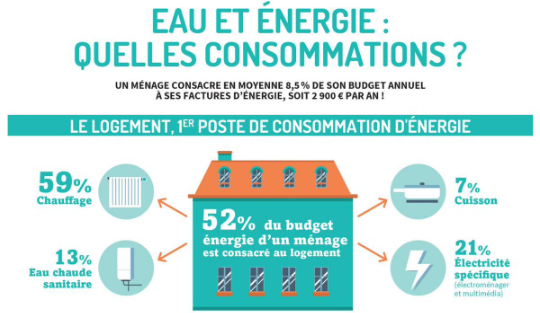
According to ADEME,*** housing and the building sector in general account for the largest share of per capita energy consumption, with heating (59%) being the primary source of energy use, followed by electricity (21%) and domestic hot water (13%).
Thus , one of the major initiatives in building a Smart City lies in the technical energy retrofitting of urban buildings. While modernizing infrastructure, improving operations, and raising public awareness are key elements, the foundation of this work remains the collection of reliable and interpretable data.
Data collection is thus made possible by the combination of long-life sensors, high-performance wireless networks, and data visualization and management applications. To quote the American author and management theorist Peter Drucker, “What gets measured gets managed.”
Some of the key examples of smart city applications include monitoring CO2 emissions, temperature and humidity levels in soil and buildings, detecting leaks in factories, monitoring waste levels in public trash bins, and managing parking areas …
Enless Wireless’s monitoring solutions can address most of these issues. Visit https://enless-wireless.com/ to learn more .
Spotlight on recognized smart cities:
The online media outlet Smart Cities World, which focuses on smart cities and smart infrastructure, has ranked the urban networks of Singapore, London, and Barcelona among its top three smart cities.
Singapore is noted for its efforts to promote easier mobility, enhanced safety, and measures to protect public health.
The example of Barcelona illustrates how the implementation of the IoT in the city (for data collection initiatives) has led to the creation of 47,000 jobs. For instance, the city has achieved savings of 42.5 million euros in its water management.
The United Kingdom is also noted for its overall commitment to the sustainable transformation of its cities. London and Bristol (which ranked highly in the 2017 Smart City Index) have optimized their inter- and intra-urban connectivity and mobility; they have redesigned their infrastructure to accommodate quantitative and qualitative demographic shifts and have worked to improve data integration. However, the instability surrounding Brexit in this region is placing significant financial pressure on the area. A decline of approximately 36% in government investment is expected by the end of 2019; this will undoubtedly impact the pace at which cities evolve into sustainable urban areas.
Major challenges
The growing development of smart cities around the world is presenting new challenges for governments. They must now address new issues related to the processing of personal data. In this regard, abuses have been observed in the collection and processing of private data and the surveillance of populations. The example of social profiling in China is currently the most striking.
Citizens also play a role in how quickly smart cities emerge, since another key challenge lies in educating the public, whose influence on how tax revenues are allocated should not be underestimated.
* Source: Weforum
** Source: https://www.openaccessgovernment.org/
*** Source: Ademe
Click on the icons below to share this article on social media >>>